Degree and Graduation Documents
- Degree Certificate
- Graduation Certificate
- Diploma
China-side document review and coordination for a China-issued Degree Certificate or Graduation Certificate intended for overseas use, including notarization, translation and Apostille preparation. The correct route and final acceptance depend on the destination and receiving organization's current requirements.
Request a Degree Apostille ReviewA China degree apostille is an authentication certificate used when an eligible Chinese academic document will be presented in a country or territory that accepts the Hague Apostille Convention route. It generally authenticates the relevant signature, seal, stamp or official capacity attached to the public or notarized document.
An apostille does not verify the academic qualification itself and does not confirm that every statement in the underlying document is true. The receiving organization determines whether an apostille, degree verification, translation, notarized copy or another document format is required.
A degree apostille may be requested when a Chinese academic document is submitted for overseas employment, professional licensing, university admission, immigration, company compliance or another international purpose. It is generally relevant only when the destination and receiving authority accept the apostille route for that document and use.
Where the Apostille Convention is in force between China and the destination and applies to the document's intended use, an Apostille is generally used. For a destination where the Convention does not apply, consular legalization may still be required. Check the HCCH Apostille Convention status table, then confirm the current route with the destination and receiving organization. See our Embassy and Consular Legalization guidance when the Apostille route does not apply.
Eligibility and preparation depend on the document, issuing institution and receiving authority.
Before requesting service, review the difference between a Chinese Graduation Certificate and Degree Certificate and confirm which record the overseas recipient requires.
These processes serve different purposes and should not be treated as interchangeable.
Verification checks information about the credential, institution or study record through an appropriate academic verification source. It is used to confirm academic information rather than authenticate a document's official signature or seal.
An apostille authenticates the relevant signature, seal, stamp or official capacity connected with an eligible public or notarized document. It does not replace academic verification when the receiving organization requests verification separately.
The exact sequence may vary depending on the document and authority.
Check the destination country, intended use and receiving authority's instructions.
Identify the academic record, issuing institution and available original or copy.
For graduation or diploma documents, degree certificates and transcripts issued by Chinese educational institutions, arrange prior notarization. Confirm the precise notarial form, supporting evidence and whether an acceptable copy or verification is needed.
Prepare a certified or notarized translation when the recipient requires one.
Submit the eligible public or notarized document through the applicable channel.
Review visible certificate details before arranging document return or delivery.
Prepare the information needed for an initial case assessment. Providing it does not guarantee that an Apostille can be issued or that the receiving organization will accept the completed document.
Current China MFA guidance requires graduation or diploma documents, degree certificates and academic transcripts issued by Chinese educational institutions to undergo notarization in China before the eligible foreign-related notarial certificate proceeds to Apostille. The precise notarial form, supporting evidence and translation requirements may depend on the document and receiving organization's requirements.
China's Ministry of Foreign Affairs is the competent authority for issuing Apostilles in China. Local Foreign Affairs Offices authorized by the Ministry may also issue Apostilles within the scope of their authorization, as recorded in China's official declaration to the HCCH.
The receiving organization may request a certified translation, notarized translation or a specific language and format. The correct sequence depends on the academic document, destination and submission instructions.
The estimated processing time may vary depending on the document type, issuing location, notarization and translation requirements, authority review and whether additional records are requested.
Public holidays and courier delivery may add time. After reviewing the case, Global Attest can provide an estimated schedule, but the final timeline remains subject to the relevant authorities.
These eight redacted pages show a degree document, its translations and notarial certificates, and the accompanying China apostille. Select any image to open the full-size version.

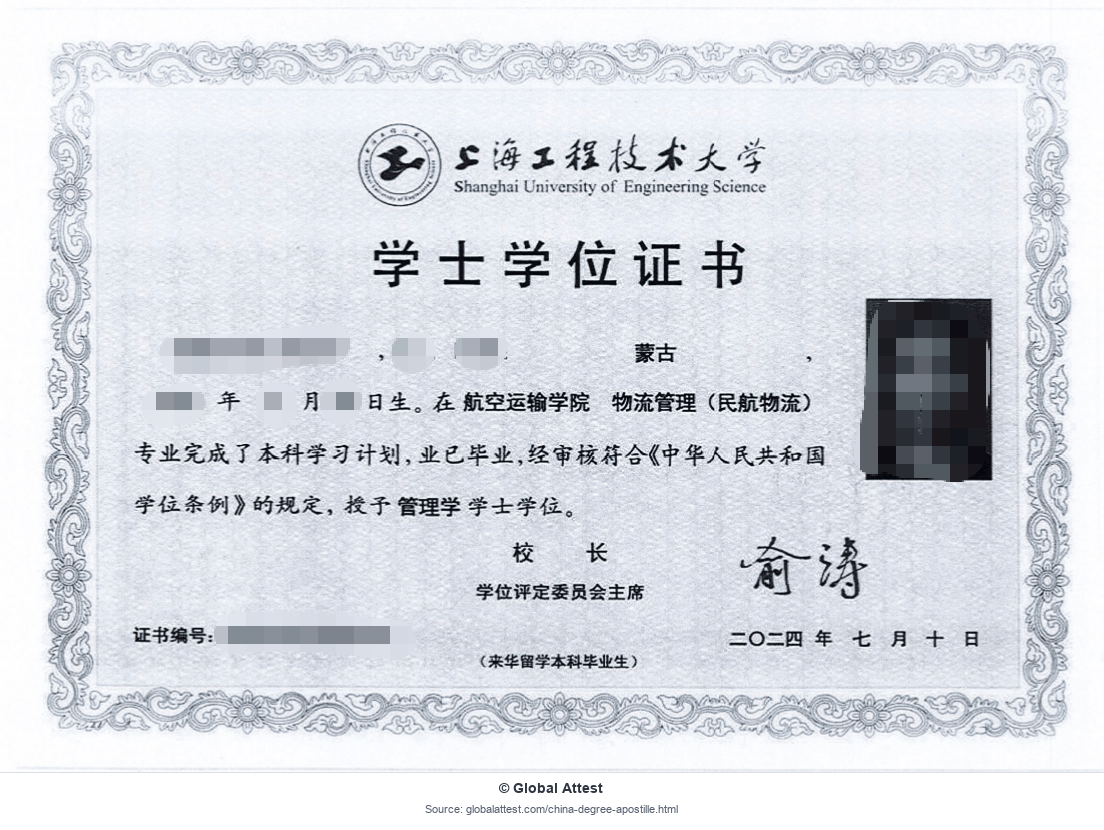
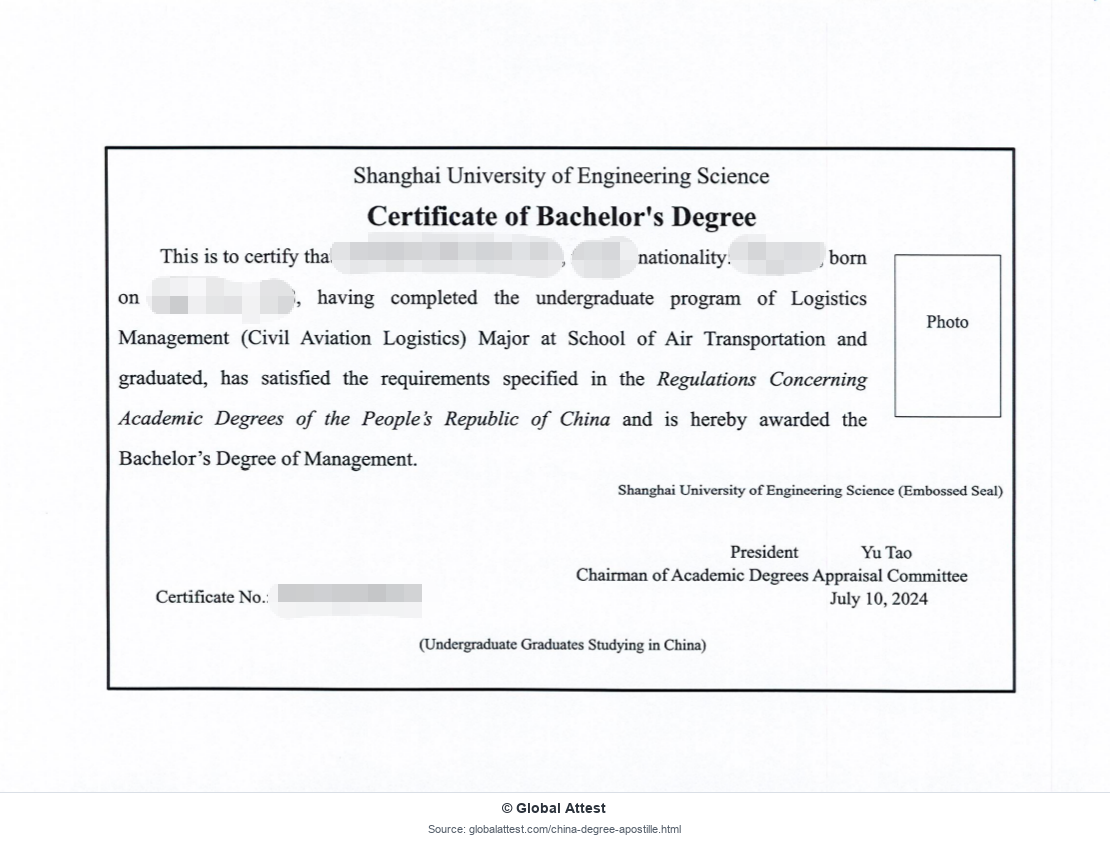
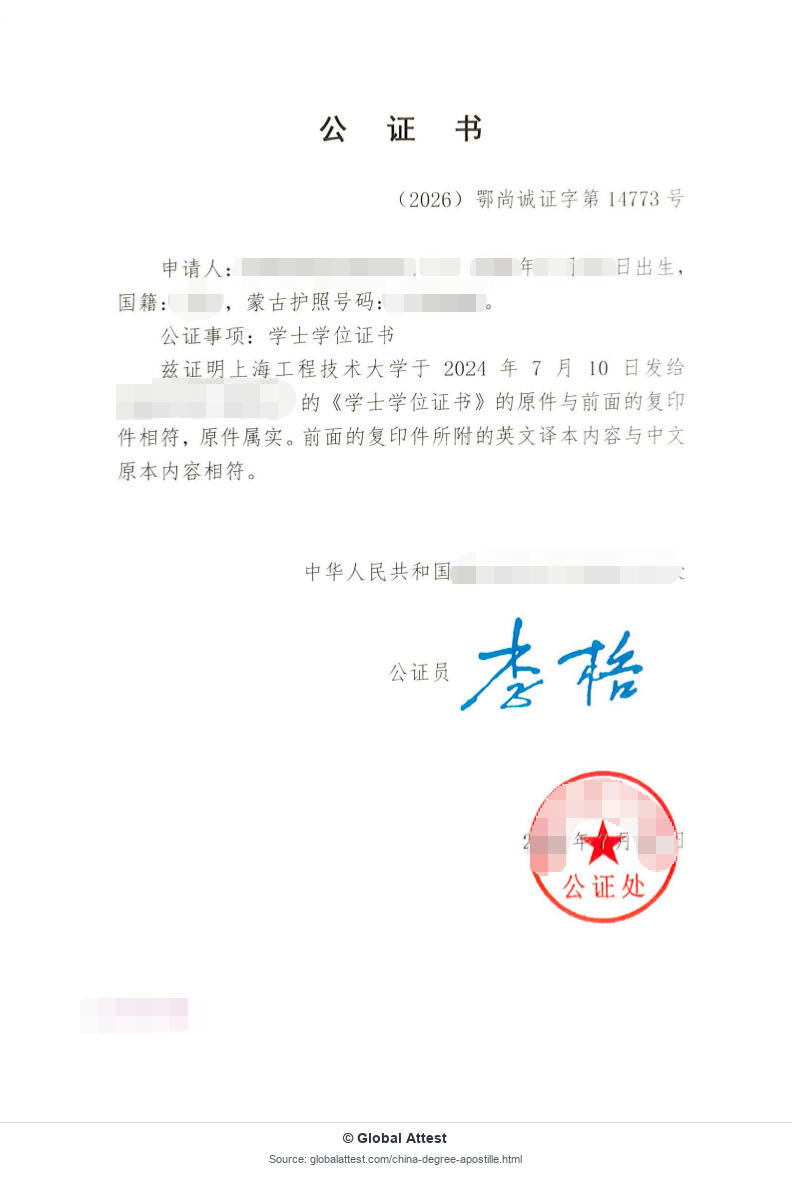
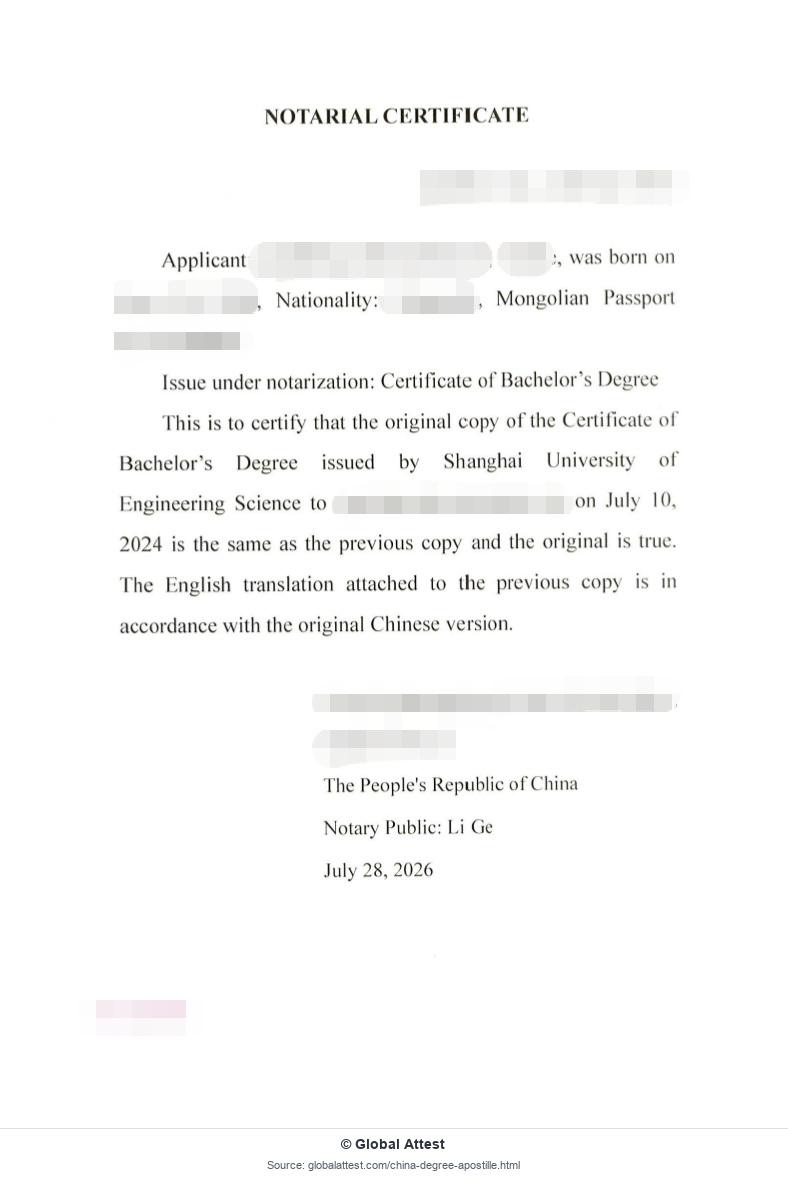
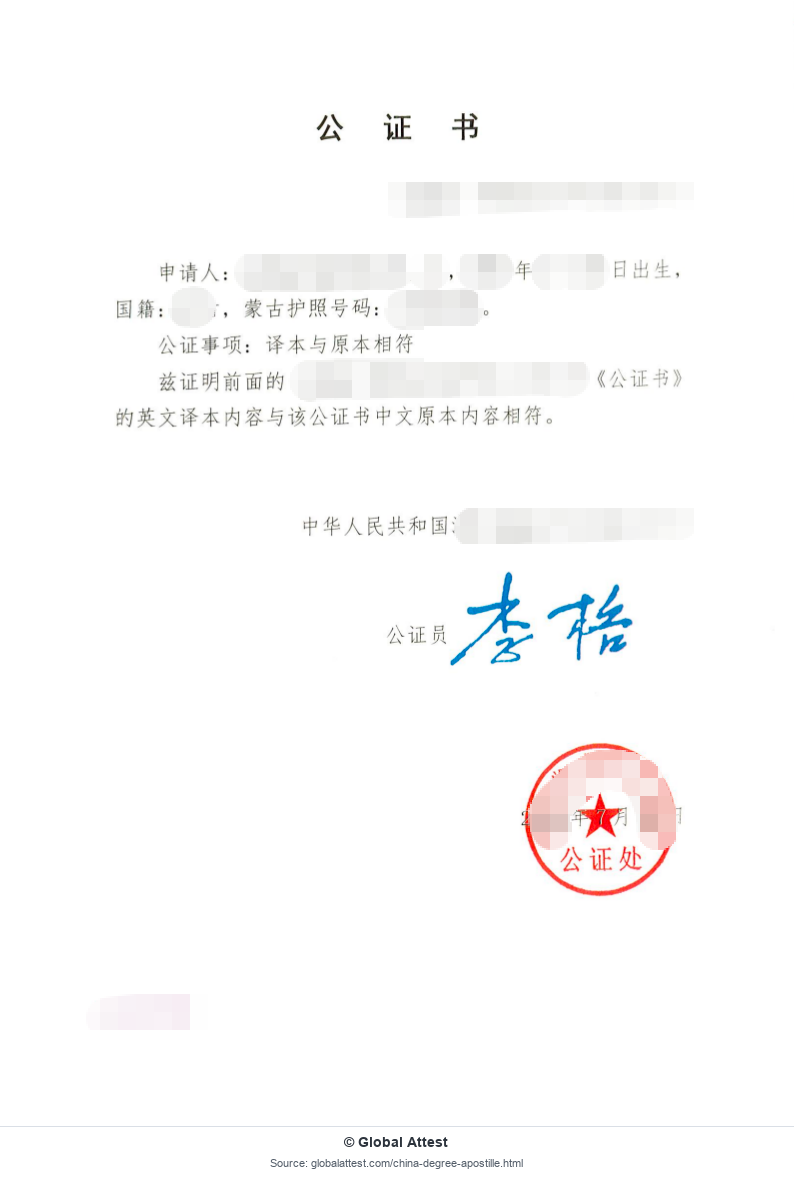
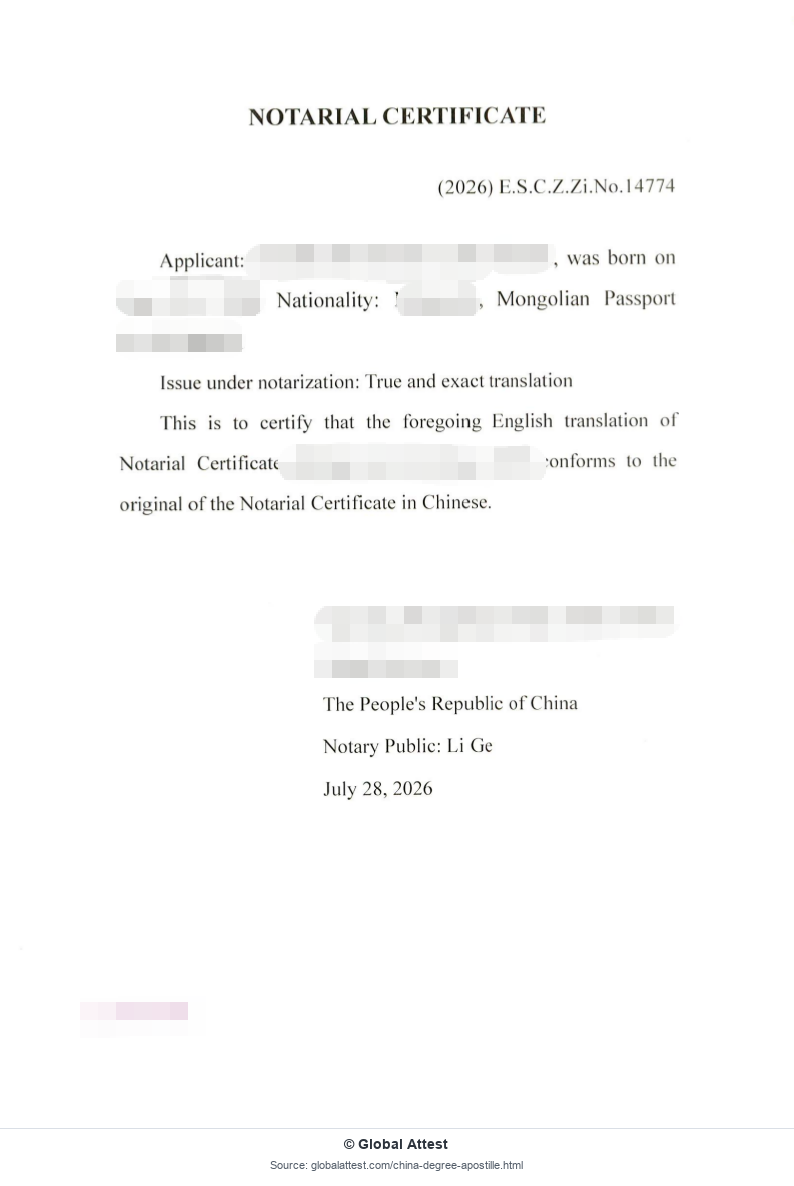
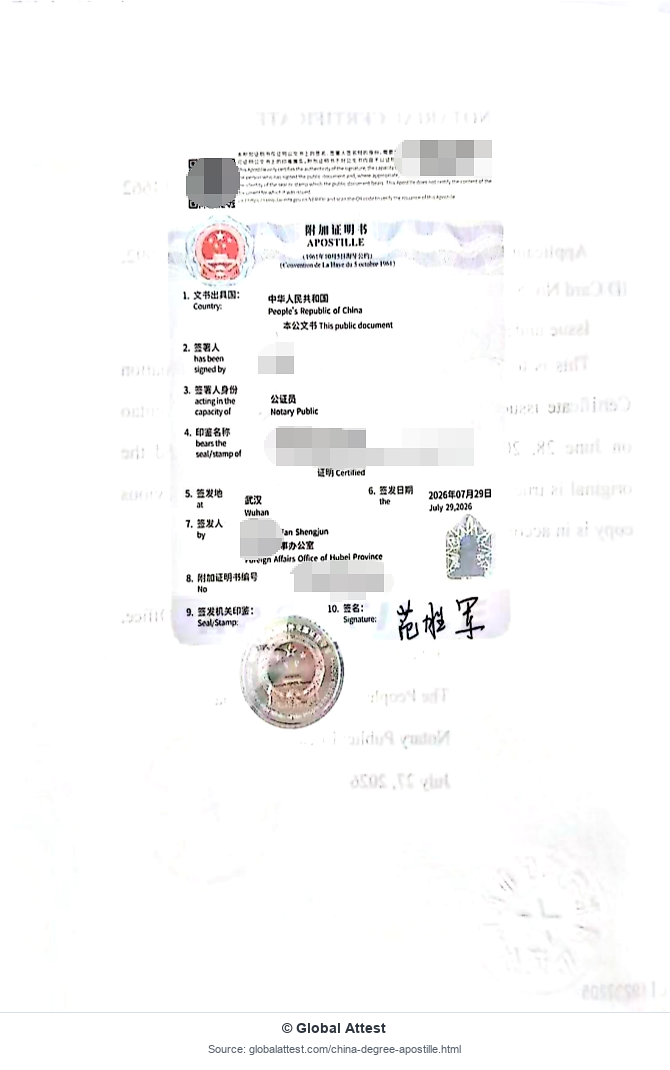
These redacted sample images were prepared and published by Global Attest for reference purposes.
You may reference these images for informational purposes provided that:
Commercial redistribution is prohibited without permission.
© Global Attest — image scan, redaction, arrangement and publication. Underlying document rights remain with their respective issuing authorities or rights holders.
Use these focused pages to understand the relevant service, verification or document route.
Review apostille assistance for eligible personal, academic and commercial Chinese documents.
View additional certificate examples and common apostille details.
Learn about verification of Chinese degrees and academic transcripts.
Understand CHSI and CSSD academic verification reports and terminology.
Review apostille, legalization, notarization and translation support.
Understand when embassy or consular legalization may be required.
Prepare Chinese degree and transcript documents for WES evaluation.
A China degree apostille is an authentication certificate used when an eligible Chinese academic document will be presented in a destination that accepts the Hague Apostille Convention route. It generally authenticates the relevant signature, seal or official capacity attached to the document. It does not verify the academic qualification itself or guarantee acceptance by the receiving institution.
Graduation or diploma documents, degree certificates and academic transcripts issued by Chinese educational institutions can be prepared through the applicable notarization-first route. Current China MFA guidance requires these records to undergo notarization in China before the eligible resulting foreign-related notarial certificate proceeds to Apostille. Enrollment or attendance certificates, professional qualifications and other academic records require separate assessment.
No. Degree verification checks information about the academic credential, institution or study record through an appropriate verification source. An apostille authenticates a relevant signature, seal or official capacity on an eligible public or notarized document for international use. A receiving authority may request one process, both processes or additional documentation, depending on its purpose.
Yes, for the Chinese educational records covered by current China MFA guidance, including graduation or diploma documents, degree certificates and transcripts issued by Chinese educational institutions. These documents must first undergo notarization in China, after which the eligible foreign-related notarial certificate may proceed to Apostille. The precise notarial form and supporting requirements can still vary by document and receiving organization.
Translation is a separate service and is not automatically included in an apostille. The receiving organization may request an English or destination-language translation, a certified translation or a notarized translation. Translation timing can also vary by procedure. Global Attest can coordinate suitable translation preparation after reviewing the document and the recipient's instructions.
The estimated timeline may vary depending on the academic document, issuing location, notarization needs, translation, authority review and whether additional records are requested. Public holidays and courier delivery can add time. After reviewing the available documents and destination requirements, Global Attest can provide an estimated schedule, but processing remains subject to the relevant authorities.
In some cases, an academic document apostille can be coordinated after the holder has left China through an authorized representative or document assistance process. Availability depends on the original document, issuing location, notarization requirements and local authority rules. Original documents, identification or authorization materials may be required, and not every part of every case can be completed remotely.
WES document requirements depend on the evaluation type, credential, issuing institution and current submission instructions. An apostille should not be assumed to replace degree verification, transcript delivery or other WES requirements. Applicants should check the latest WES instructions for their case and prepare the academic documents in the exact format and submission channel requested.
Global Attest is an independent document support provider. We are not the Chinese Ministry of Foreign Affairs, a local Foreign Affairs Office, a university or a receiving organization. The relevant authorities determine the applicable procedure and issuance, while the receiving organization determines final acceptance. Apostille, notarization, translation and academic document requirements may vary by destination and document type.
Request a Degree Apostille Review